

How to choose a practical Built-in Wardrobe for a small apartment: An expert guide to maximizing space
When planning furniture for a limited space, standard solutions often disappoint. In small apartments, every centimeter is critical. To create a space that is both visually aesthetic and functionally spacious, custom-made built-in wardrobes are the best choice for small apartments.
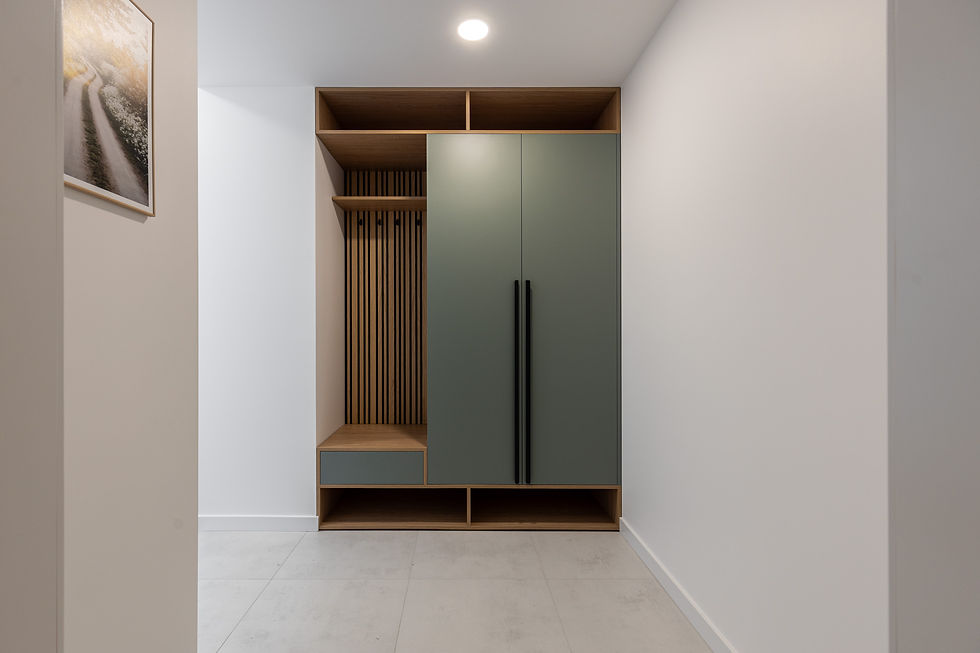
With over 30 years of furniture manufacturing experience in Latvia, RIPO Factory delivers top-quality solutions where every detail is thought out to the last millimeter. In this guide, our engineers and designers share their expertise on how to properly plan a built-in wardrobe, select materials, and optimize costs.
1. Ergonomic Planning and Space Geometry
In small spaces, ergonomic planning is the first and most crucial step. Unlike freestanding furniture, a built-in wardrobe is integrated directly into the building's structure (from floor to ceiling and from wall to wall), thereby eliminating "dead zones" where dust accumulates.
Technical specifications for an ideal wardrobe:
Total depth: Standard clothes hangers require at least 60 cm. If choosing sliding doors, an additional 8–10 cm must be added for the door system itself. For very narrow spaces, a depth of 45 cm can be used with perpendicular (pull-out) clothing rails.
Height: Utilize the full height of the room right up to the ceiling. Season-specific items or suitcases can be stored on the upper shelves (above 210 cm).
Zoning: An efficient wardrobe should consist of three zones: active (at eye level), passive (bottom/shoes), and seasonal (top).
2. Door Mechanisms: Sliding vs. Hinged Doors
In small apartments, the door opening radius can block walkways. Here is a technical comparison to help you make the right decision:
Parameter | Sliding Door Systems (RIPO Aluminium) | Hinged Doors |
Space saving | Excellent. No space is required in front to open the doors. | Clear zone required within the door radius (at least 50–60 cm). |
Access to content | One-half or one-third of the wardrobe is visible at a time. | Opening all doors displays the entire content of the wardrobe. |
Required depth | Deducts about 8–10 cm from the internal wardrobe depth. | Deducts only the hinge space (1.5–2 cm). |
Aesthetics | Ideal for mirrored surfaces (expands the space). | Modern, minimalist design with hidden handles (Push-to-open). |
3. Materials and Hardware: RIPO Factory Quality Standards
The longevity of a wardrobe is determined not by the facade, but by its internal structures and hardware. In its production facility in Latvia, RIPO Factory uses only tested and certified materials.
Carcase and shelves: High-quality Austrian or German laminated chipboard (EGGER, Kronospan) with a thickness of 18 mm (cheaper alternatives often use 16 mm, which sags over time).
Edge banding: All visible and concealed edges are treated with 1 mm or 2 mm ABS plastic edging using moisture-resistant PUR (polyurethane) adhesive. This prevents moisture penetration and material swelling.
Hardware and runners: RIPO Factory uses hardware from world leaders Blum and Hettich. Soft-close mechanisms (damping) ensure that doors and drawers close silently—which is critically important in one-room or studio apartments.
4. Visual Tricks for Expanding Space
To prevent a small built-in wardrobe from looking bulky, the right visual solutions should be applied:
Mirrored facades: Silver or bronze-tinted mirrors double the perception of space and reflect light.
Monochrome tones: Wardrobe doors in the same color as the room walls (e.g., matte white, light gray, or cashmere) make the furniture virtually "invisible."
Integrated LED lighting: Built-in LED strips with motion sensors not only help you navigate the wardrobe contents but also serve as an additional mood light source in the room.

Frequently Asked Questions (FAQ)
How much does a custom built-in wardrobe cost?
The price of a built-in wardrobe is determined by exact dimensions, the selected materials (laminated chipboard, MDF, glass, mirror), and the complexity of the hardware. Wardrobes manufactured by RIPO Factory are custom-designed to fit the client's budget while maintaining uncompromising quality and ensuring the best long-term value.
Why choose RIPO Factory instead of a ready-made wardrobe from a supermarket?
RIPO Factory offers over 30 years of experience, local production in Latvia, and a full-service experience—from measurements and 3D sketching to professional installation. Ready-made wardrobes often fail to fit the specific dimensions of a small space, leaving unused gaps, whereas a RIPO Factory wardrobe is integrated with millimeter precision.
What is the optimal wardrobe depth for clothes on hangers?
For a classic layout, the optimal usable depth of the wardrobe is 60 cm. If sliding doors are planned, the total niche depth should be at least 68–70 cm so that the door mechanism does not touch the clothing.
How long does the wardrobe manufacturing process take?
The manufacturing process at RIPO Factory (from sketch to installation) typically takes 4 to 6 weeks from the moment of final project and estimate approval. The exact timeframe depends on material availability and the complexity of the project.


Comments